Re-reading A Potter’s Book
There's someone in one of my classes who is a great student of culture, of design & art history, & who, since being at the studio, four or five years now, has become interested in ceramics history too. I'd call him a student of mine except that these days I learn as much from him as he (hopefully) learns from me. A colleague.
One area he's exploring at the moment is Mingei, and how a particular Japanese aesthetic ideal got picked up by American studio potters so enthusiastically, so suddenly, and how Mingei became influential in American clay. At least through the second half of the 20th century. My own work, of course, is in this category of being heavily influenced by Japanese folk pottery, or what I imagine this pottery to be.
We should do a talk on this, my colleague said, knowing that if we scheduled a talk we would both be forced to pull our thoughts together & learn more about the topic.
Sure, I said. Mingei in America. That would be a great topic for a slide talk. Then I sighed, and rummaged through the studio library. Many of the books it contains were donations by other potters, over the last twenty-five years, closing their studios and wanting to make sure their well-loved books, the ones that they learned how to be a potter from, would go somewhere, would be read again, would still mean something. Marguerite Wildenhain's Pottery Form and Expression. Fred Olsen's A Kiln Book. Stoneware and Porcelain by Dan Rhodes. In a way my studio library, a jumble of books in the gallery & kitchen of our Lena Street studio, is a little time capsule of the Studio Potter movement.
I pulled out a very musty old hardback, and handed it to my colleague. I guess we're going to have to re-read A Potter's Book, I said. Or at least, I'm going to have to. Want this copy? I have like five of these.
That's okay, my colleague said dubiously. The old hardback I'd offered had clearly been decades in someone's dusty studio, maybe a damp old New Mexican adobe with a cement floor, or dirt floor, probably mice.
I think I'll get a new copy online.
Good idea, I said. There’s no shortage.
I remember encountering this book by Bernard Leach for the first time. I had just moved to New Mexico, and though I was working a 'regular' job, I needed to work in a clay studio. There was one potter up in Dixon (actually at that time there were four or five outstanding studio potters) and I just walked in & asked if I could, like, apprentice? Like, do some work, and then just, learn?
Okay, the potter said, my first real teacher & a lasting influence. Only, he said, don't quit your regular job. You can call, and come up, sometimes. Not always.
I would park, and walk in, and despite himself, my teacher would be pleased. I'd set out bisqueware I'd bravely made in my own little studio, and he would look dubiously, yet somehow happily, at the forms. He'd drag out the glaze buckets. Probably we ought to sieve these buckets, he'd say. You see how they're pretty settled out. You think we should sieve them? We're gonna have to load the kiln today. We’re gonna have to glaze.
I don't know, I would say. If you want, I can sieve. Like, just, pour the buckets through here?
I would listen, and he would talk. Warren MacKenzie, Marie Woo, the way American potters put extra soda ash in their Shino glazes, when really the sodium is supposed to come from the feldspar itself. Feldspar makes things melt, and silica makes things not melt, my teacher said. I've repeated that to myself ever since. Occasionally he'd get exasperated with my just hanging around.
I'm going to give you a book, he said once, and rummaged through his own library, studio potter books, a lot of farming books too. I've got like five extra copies of this one, he said, pulling out A Potter's Book. Read this and see if there are any ideas in it for you.
Okay! I said, excited. Reading books – probably I’ll take notes — that’s the one thing I’m good at.
Wait a minute, he said, scrambling for a pen on his kitchen counter. He read in the kitchen, and threw pots on the portal with his Shimpo RK-2, and trimmed in the little livingroom of his old adobe. Let me just inscribe this here.
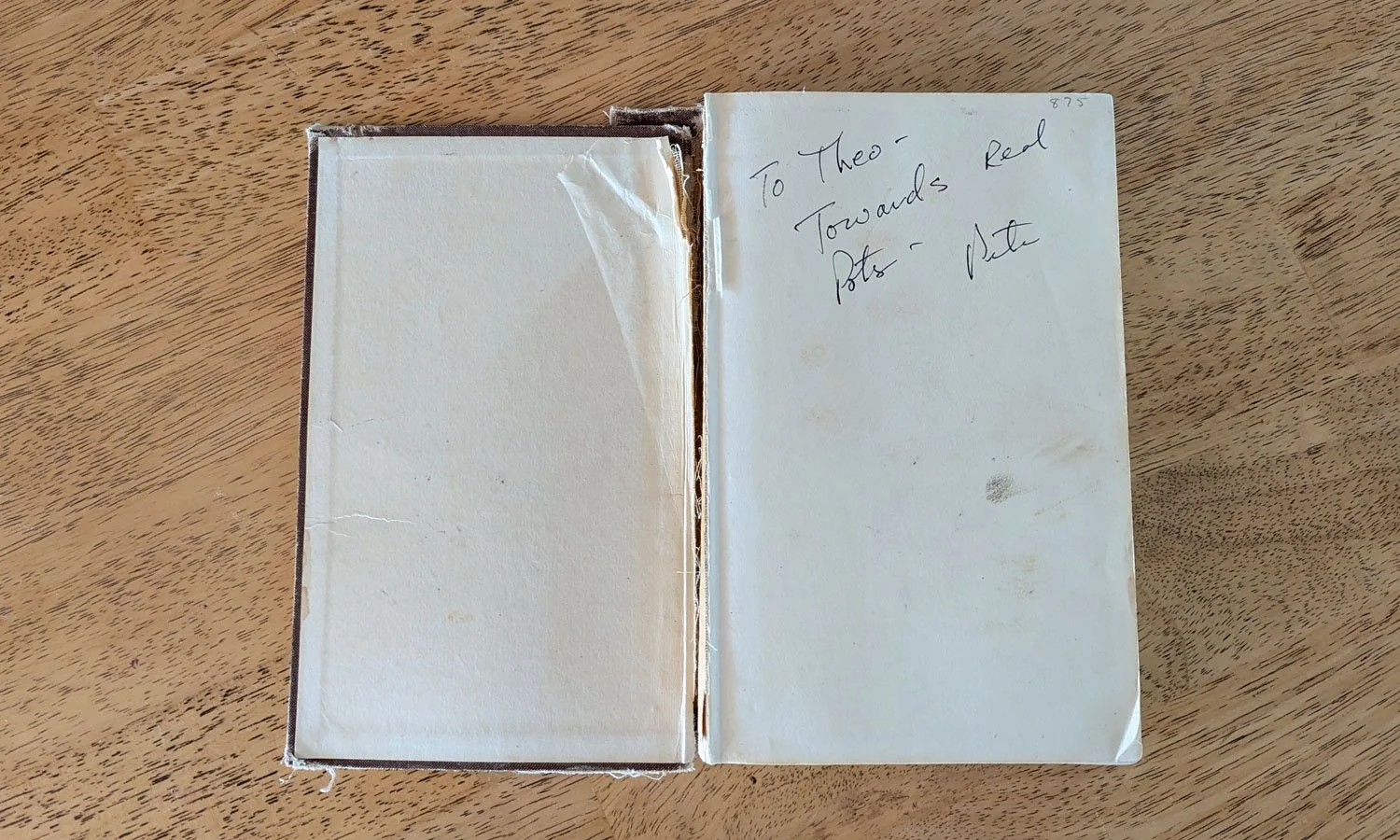
That was nineteen eighty-nine. Now thirty-seven years have passed. I am aware that as I take up A Potter’s Book again, part of the encounter will be with its ideas, and part will be with my former self, the ‘me’ who set out to be a potter, a wary, suspicious, twentysomething.
The first chapter is called Towards a Standard, and the goal is to realize a way to measure the beauty of pottery, a way to select the 'good' pots from the 'bad'. Toward this, Leach makes several assumptions:
that hand-made pots should be judged separately from factory-made, which are always bad
that adherence to tradition is important for good pots
that the Chinese pots from the Song Dynasty, 960 – 1297, are the best 'good' pots
The chapter complains about the 'over-accentuated individualism' of western industrial society and the 'general arrogance of our materialism.' We are urged to look to supposedly Eastern values as we develop a standard to measure good pots, and he quotes Yanagi Soetsu at length, for whom beauty should be accompanied by 'the nobleness of poverty.' The Japanese term shibui — austere, subdued, restrained — is meant to clarify what the aesthetic standard for pottery should be.
I can see my former self reading these pages, and I can feel his suspicion. I'm aware that when I first read this book I read it because my teacher gave it to me rather than because I was likely to believe much of it. I wanted to know what other potters thought about, and I held off accepting any of these ideas myself. Why should pottery be austere? That's fine for some pots. Jot this down — austerity is an accepted value among studio potters — kind of random though.
I'm aware that when I first read this book I also was suspicious of the patrician British tone. The tweedy satisfied author represented, for me at the time, the confinement & expectation, the rightness & fastidiousness, that I was at that time of life in retreat from. I became a potter to get away from voices like Leach's. I wanted to be a curmudgeon like my teacher, in an old adobe, somewhere in an old village on the High Road to Taos.
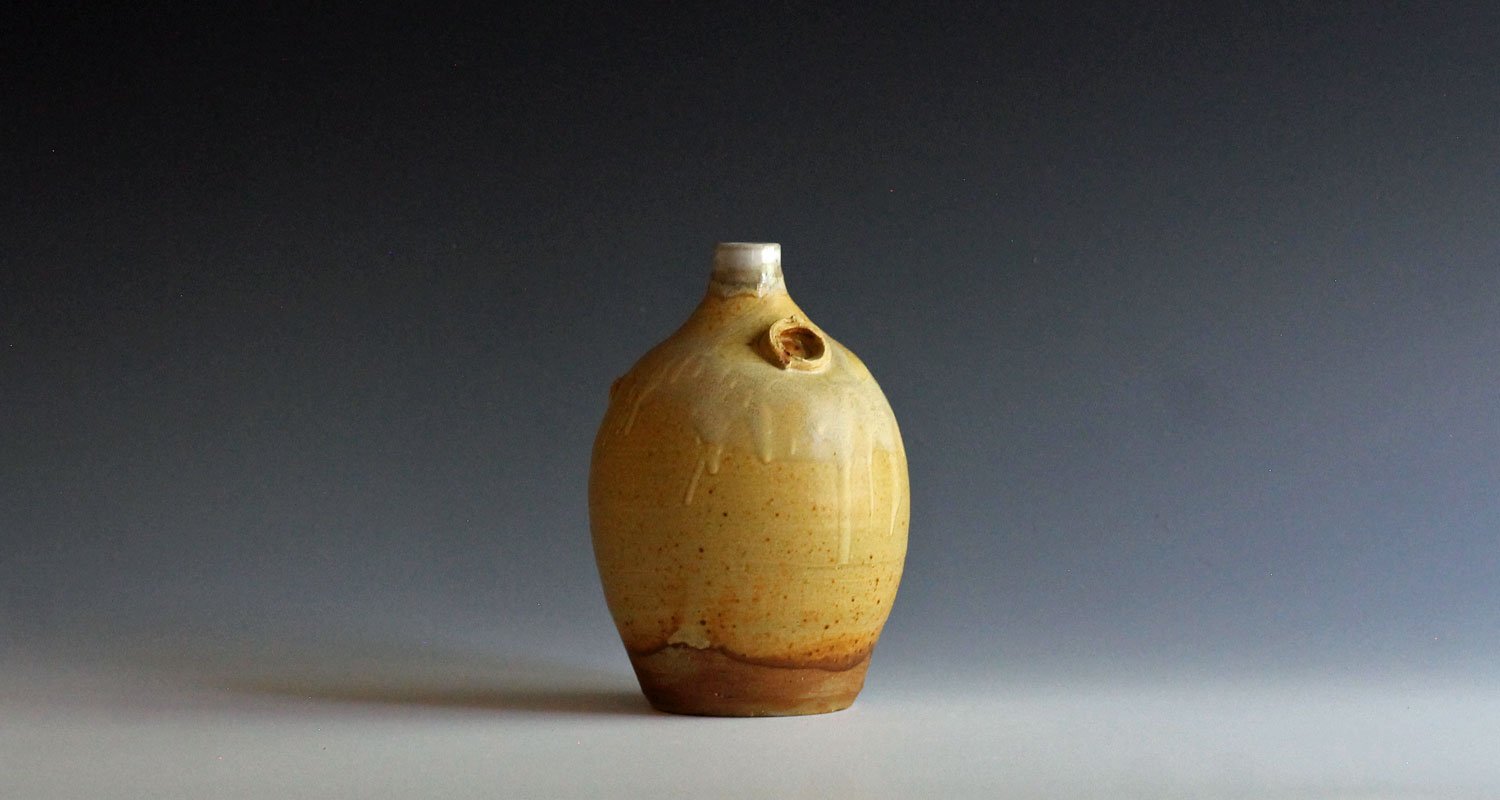
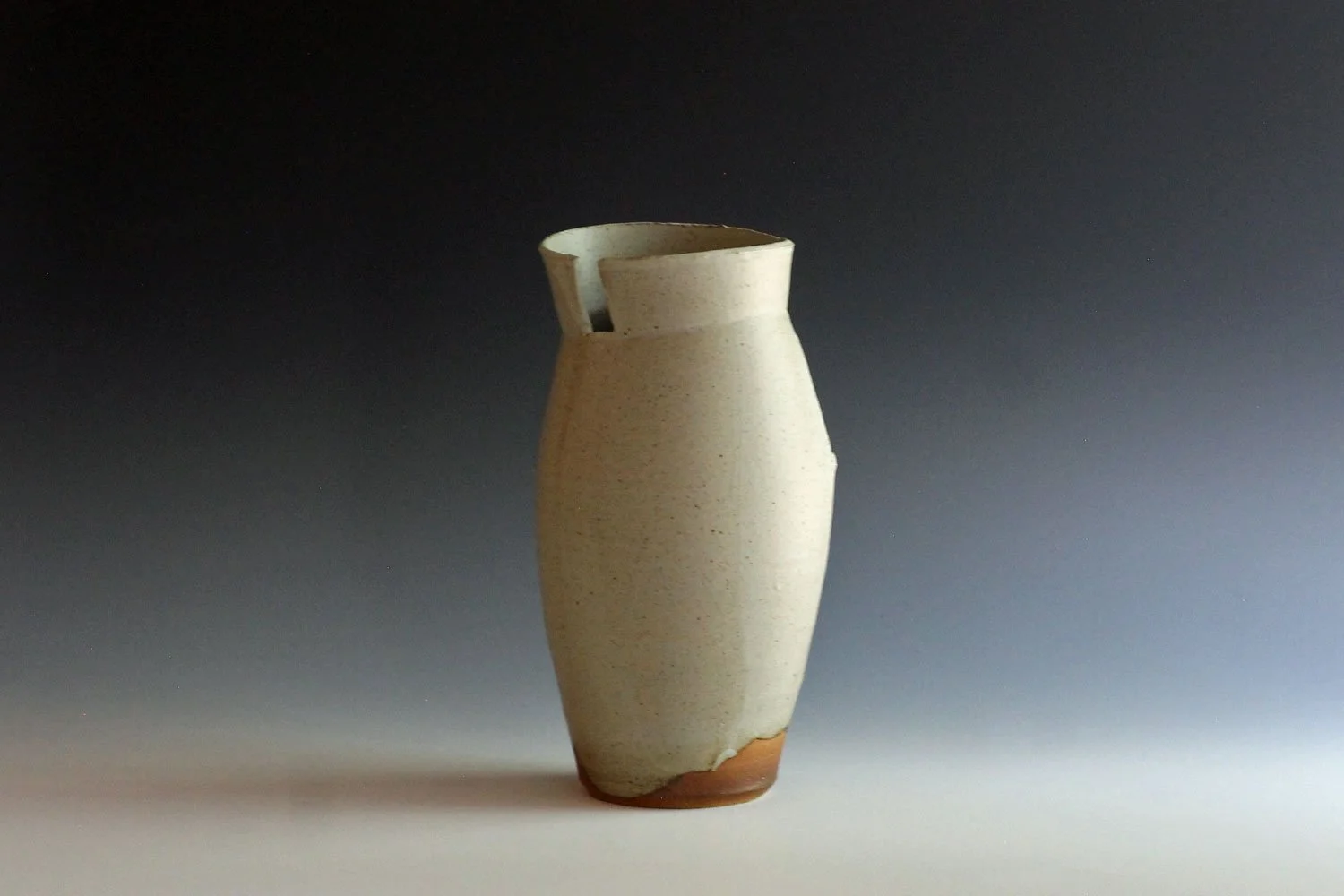
As I re-read, years later, hmm. I must concede, at the least, that the photos included in chapter one show really good pots, the kind I would want my own students to look at. Maybe they’re austere, they do guide one to look at form before surface though, and to ‘feel’ the materiality of the clay, the substance, of the overall pot. Sincerity, Leach says over and over in chapter one, and vitality. Those words are so vague as to barely be useful — as my son would say though, they are not wrong.
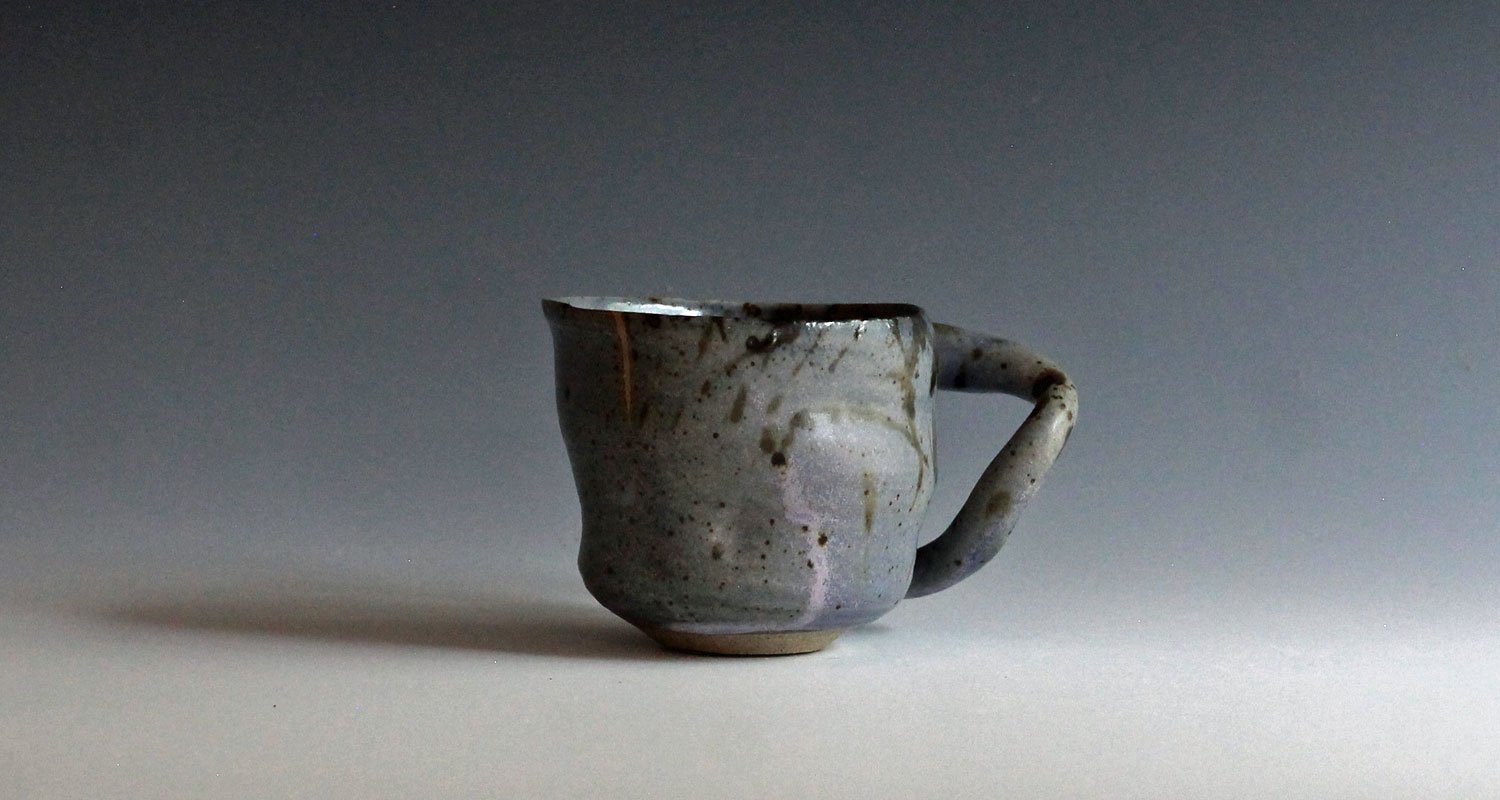
As I finish re-reading chapter one, today, these many years later, on my desk here is a pot made by an intern last January, one of a series of pieces he made, mugs with handles. I want to think about handles, he said. He made mugs, like fifty, too many to fit in his suitcase for the flight home.
Well, I said. I looked dubiously, yet somehow happily, at the work. If you have any extras I could take one or two. Just for our permanent collection here. For our library?
Probably he could tell the one I wanted, and left it out on purpose – a deep, blue, heavy, mug with a narrow foot & a handle made from a coil of clay that seems to loose its way, leaving the rim, before it attaches near the bottom of the form. A dark tenmoku glaze is trailed & spattered on the blue. I felt like I wanted the cup – like I needed it. I liked it. The rim is thin, pinching up to a close but undifferentiated & wobbly circle at the top. The weight of the handle nearly tips the cup over unless there's coffee in it.
The proof of any art’s lasting value is a comprehensive emotional necessity, Peter Schjeldahl said, and here it is — my student needed to make this cup, in order to have something to do in January and in order to learn about handles, and when I saw it I needed to have it. It is not good. It is not an accomplished mug, one would not want a set of these, or arrive at a craft fair & try to sell a table of them. The mug is not made by a potter attempting to reach a standard, it's made for personal reasons by someone who is learning. Also, you can see, someone with confidence in their own ability to learn, confidence in their hands, someone with humor, too. Someone who has understood that to learn about making mugs & handles, a good idea is to make forty or fifty of them.
Bernard Leach, is that so far off from what you wanted? The mug is not noble or austere. It is unaware of tradition. It has a sense of humor though, and you see that you have left that out of your book. Is it too late to put that back in?
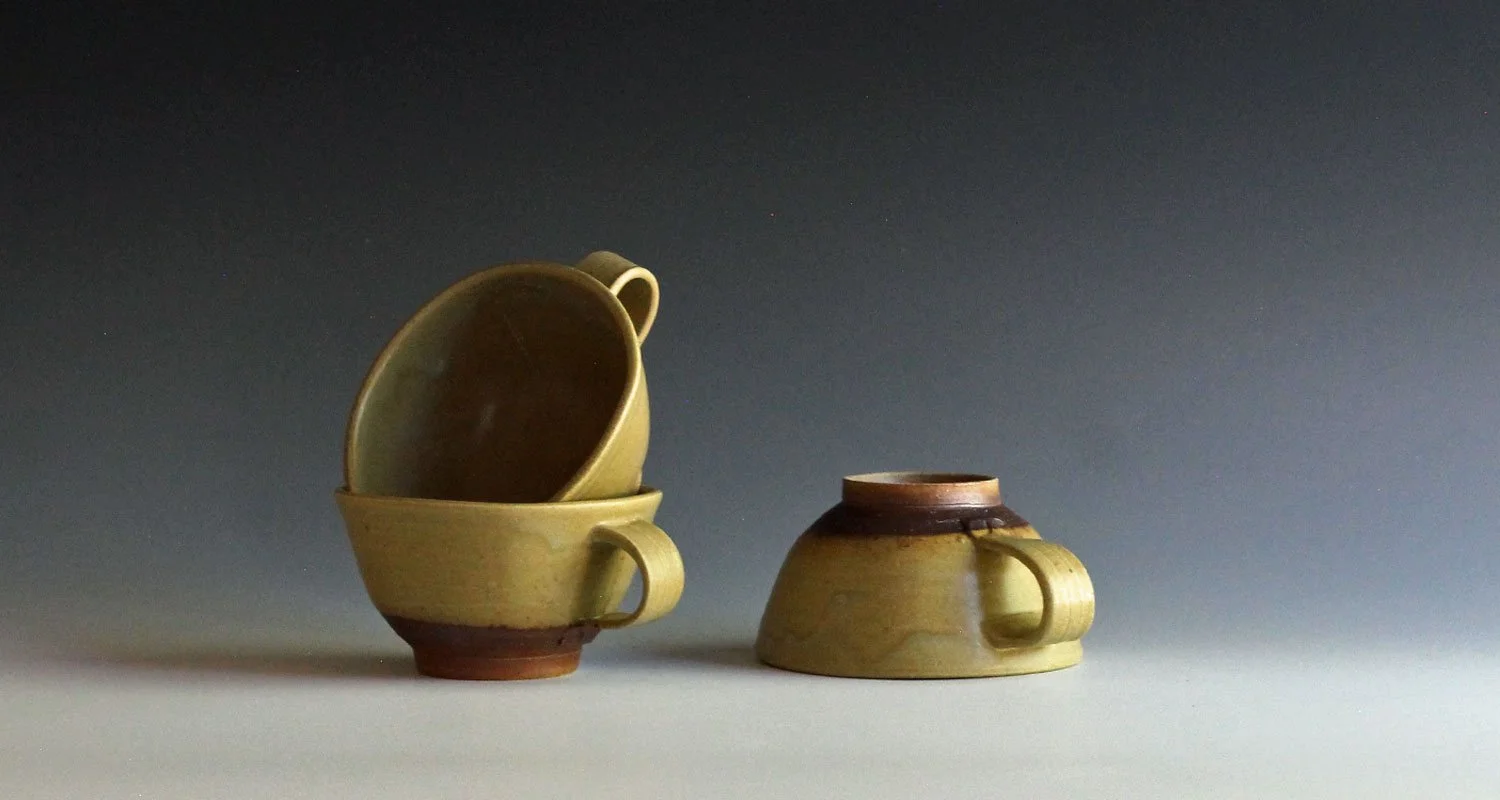
Would you be willing to revise your famous book just to add that one other element as we search for a standard for the ‘good’ pot? Humor. Other than this humble suggestion, and humility was not in my repertoire last time I read your book, nothing like years in the clay studio to awaken that, I would only say that your book has changed quite a bit over the last several decades. It has become more useful, if less practical, the pictures have gotten better, your preference for discipline & and repetition has become increasingly persuasive.
I look forward to your revisions & to seeing how your book may change over the next twenty years.